
Diana’s Low Supply Story
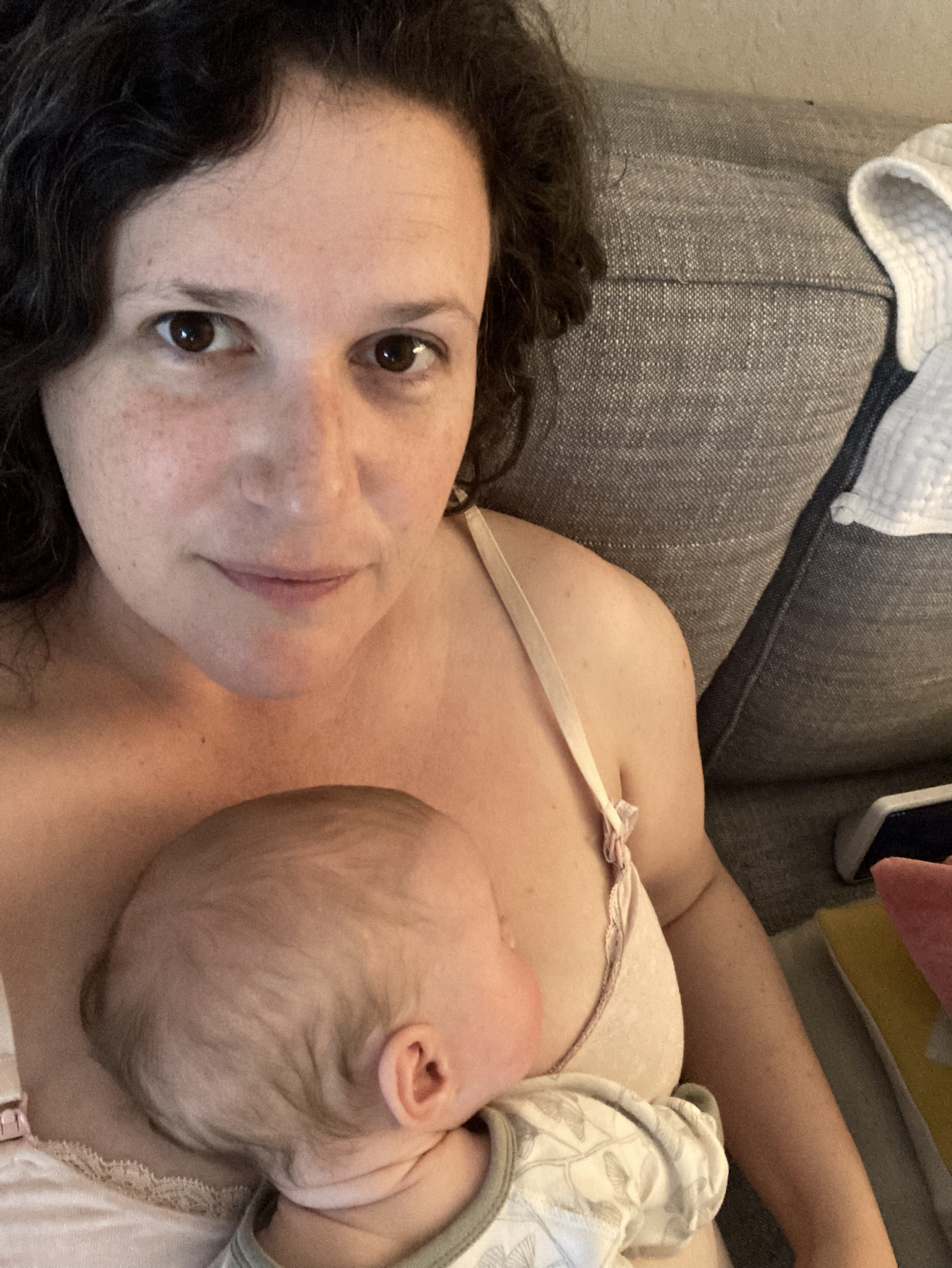 There are so many ways we can define success with low milk supply. If you would like to share your low supply story, contact us. It does not have to be this long. 🙂
I would like to start by saying this story has a happy ending, even though the beginning is rough.
Before I knew what I didn’t know
After a physically and emotionally taxing journey to my first pregnancy, I was used to doubting my body. But even I thought breastfeeding would work for me. Why? Because I believed what I was being told. My twin sister hadn’t been able to breastfeed, but I chalked it up to her giving birth in the first couple of weeks of the pandemic and not having the right support. I went to the prenatal classes, and I listened when they said that everyone could do it. And then I opened one classic breastfeeding text. I read through chapters of empowering explanations. Finally, at the end, I found a little section that had a new message. Everyone can breastfeed, the book and everything else had been telling me. But oh yeah, there are these extraordinarily uncommon things that can happen and maybe if you’re one of those exceptionally rare people, you actually can’t.
I thought about myself and my sister and put the pieces together. It was describing us. I immediately made an appointment with the lactation consultant recommended by my birth doula. And she agreed. While she couldn’t diagnose me with anything, I had risk factors for primary low milk supply, and she helped me make a plan.
This was one of the greatest gifts I could have been given as an expecting mom. My low supply didn’t sneak up on me when I was sleep-deprived, recovering from labor and trying to learn how to be a parent. I was sort of ready for it, as far as that is possible.
Welcome to motherhood
Despite all my preparation, feeding was very, very difficult, and emotional. I sustained an extremely painful pumping injury that started when I was still in the hospital, and as a result I was given a nipple shield (a piece of silicone designed to help the baby latch) by a nurse in the postpartum unit. Nipple shields can be amazing tools, but in my case it did not ultimately help us. Everyone who examined my daughter in those early days said she had a very strong suck and normal oral anatomy, but after I did my first weighted feed about five days postpartum, it was clear that even though I was an A+ student in terms of best practices, my daughter was not effectively draining my breasts, and my milk production was low. I had been doing responsive feeds and pumping or hand expressing after every breastfeeding session—some of them taking up to an hour—since we got to the postpartum unit in the hospital. (This is not what I would necessarily recommend now, but given what we knew then, it was part of the insurance plan to make sure my breasts would get enough stimulation.) We adjusted the strategy to prioritize pumping at night and triple feeding during the day with shorter direct breastfeeding sessions while we worked on helping our daughter transfer milk better.
We’d been told the nipple shield would be temporary, and the many attempts to wean from it were painful. I wish no one had to experience trying to breastfeed a baby who refuses to latch. I already knew my supply was low, and on top of that, I felt like my daughter was rejecting me. And all of this after having such a hard time getting pregnant. It was an incredibly difficult period of my life and my husband’s, even as we were simultaneously experiencing so much joy.
What we were told
It didn’t help that the possibility I might not make a full supply wasn’t fully addressed in the very early postpartum period. We are all doing our best, but I had multiple doctors (who were not experts in breastfeeding) tell me that I would be able to exclusively breastfeed, even when I mentioned that my lactation consultant and I had identified multiple risk factors for primary low supply. (A few years later when I saw a breastfeeding medicine physician, my primary low supply made perfect sense to her given my labs and history.)
We received the most confusing advice—based on the assumption that a full milk supply was guaranteed if I stayed the course—in the first few days of life. Though the weight loss had been high during our initial outpatient pediatrician visit, they had assumed the recorded birth weight had been incorrect (we later confirmed that it wasn’t; my husband had filmed our baby as the nurses placed her on the scale in the delivery room). She had lost 15 percent of her weight in three days.
At night she was extremely lethargic. It was scary. I called the 24-hour line for her doctor and left a message. In all the sleep deprivation I forgot to turn my phone off silent mode, and I missed the return call, but the nurse kept on trying until I finally picked up. She told me to give formula, and she stayed on the phone with me until I’d finished the feeding. I had no idea what I was doing. I was very grateful to that nurse.
Our daughter seemed so much better when we went back to the pediatrician the next day. Although we hadn’t wanted to introduce supplementation so early, we’d known it might need to happen given my medical history. But the doctor told us that she wouldn’t have recommended formula and that my supply was about to come in. I was very confused.
I ended up talking to a lactation consultant on the phone that afternoon, sort of by chance because she was just asking if I wanted an earlier appointment. I told her what the doctor had advised and that I didn’t know what to do. And she said, “You have to feed your baby.” It was the validation I needed. She helped me understand how much to give and to make a plan until we went back to the doctor the next day. We saw a different pediatrician who knew how to support a family with low supply, and after that our daughter did very well from a medical perspective.
Jumping ahead for a moment
When writing this essay, I discussed my first few days of motherhood with a breastfeeding medicine/family medicine doctor, and she said it would be natural to assume that 15 percent loss in three days didn’t sound right. But she also said that it would be important to look at the situation as a whole, including how sleepy my baby was, along with my risk factors for low supply. The Academy of Breastfeeding Medicine (ABM) agrees about taking the possibility of maternal low milk supply into account to avoid underfeeding. I don’t know if the doctor would have come to a different conclusion if she’d been following ABM’s guidance in this position statement, which hadn’t even been written at the time. But by her own admission, she was basing her treatment on the assumption that I was capable of making a full milk supply. I could tell that she cared and that she was doing what she thought was right, but I believe that should never have happened.
It’s also notable that she was confident that my milk was about to come in and resolve our problems, but I only transitioned from colostrum to copious milk on day five (ABM says that milk coming in after 72 hours already meets the definition of “delayed secretory activation”). My instincts were right, and something was wrong.
Reflecting on all of this now, I think that maybe things would have been fine if we hadn’t started supplementing at that particular moment, but I should have been able to trust that our baby’s doctor was considering the big picture and that she believed in the existence of—or the possibility that I could have—primary low milk supply, despite her first impressions when she looked at me. I should never have had to piece together the advice from three different clinicians to try to figure out how to keep our much loved daughter healthy, especially after going through so much, all the infertility, all the rounds of IVF, all the false hopes and anguish and—honestly—failure to finally, finally become a mother. I was already so vulnerable, and then was put in that position by an expert my husband and I turned to for help. All these years later I find myself holding onto two thoughts that are not at all incompatible: I understand that she was doing her best, and also I do not want the same thing to happen to the next family that finds itself in our situation.
My fourth trimester and beyond
In those first few months, I eventually started direct breastfeeding less frequently because triple feeding all day is not sustainable and I needed to pump to maintain my hard-won supply. We did eventually wean from the nipple shield, but my daughter never was able to effectively transfer milk and I remained pump-dependent. After a few months, she stopped being happy to suck on anything and direct breastfeeding became increasingly elusive. I was sometimes pumping up to twelve times a day, following some advice I’d picked up during my desperate internet searches. That didn’t last long and I would never recommend pumping so often because…when do you sleep? And it didn’t even help my supply.
The incessant pumping took its toll on my family. I had suffered from chronic joint pain for years, and that made it extremely difficult for me to care for my daughter while pumping. My husband ended up taking more paternity leave than he had wanted to. It was stressful for our marriage. And it took me away from my baby. It was also isolating. I felt like I was tied to a pump, and I was afraid that the new wearable pumps wouldn’t work for me because of my injury in those early days. I rarely left the house for more than a couple of hours because I felt I needed the comfort of pumping in my own space, and I had worked so hard to establish my supply and was extremely worried that it would go down—with no hope of being recovered—if I changed my routine.
Even with all that effort, I was making a fraction of what my daughter needed, and I pooled it together into one bottle a day. At that point in the pandemic, the immune properties from my milk were so important to me. I’d seen a talk with a doctor who said that breastmilk had a temporary coating effect for immunity, and it gave me comfort to feed my own milk to my daughter before we had to go indoors somewhere, like for a pediatrician visit.
An ending
Months passed. My daughter got her COVID vaccine on her first birthday, just as it became available, and I felt an enormous sense of relief. I started working with my fertility doctor again. She wanted me to stop lactating, and although it felt strange to me, I was ready to do it since I knew that my daughter and I would spend more time together. I agree with breastfeeding medicine physician Dr. Katrina Mitchell that the term “goals” is not necessarily productive when it comes to breastfeeding, especially for people with low supply, but I had wanted to make it to a year, which the American Academy of Pediatrics (AAP) recommended. And as I was intentionally letting my supply dwindle, I learned that AAP had just changed its guidance and was now aligned with WHO in recommending breastfeeding for two years or longer. Even though as a professional I now understand this change, at the time it felt a bit like a slap in the face. I sighed and moved on, and was lucky enough to get pregnant again fairly quickly.
And a new beginning
Now for the happy ending. In my second pregnancy, I didn’t just guess that I would have primary low milk supply; I knew it. So I planned to do things differently. I would be very unlikely to make a full supply, and my mission became setting myself up for my version of success with direct breastfeeding and effective milk transfer. I took another prenatal breastfeeding class to learn about how to achieve an effective latch, since that part of our feeding relationship had been so fraught and transient. I read everything I could find about low milk supply, and I made a new plan with my lactation consultant. When my daughter was born, we focused on effective direct breastfeeding, and we were very lucky that she excelled at this. I did some pumping in the beginning but I wasn’t obsessive about it. I let myself get a five-hour stretch of sleep before midnight while my husband took care of the baby. It felt like taking back a bit of my power; I knew my body likely would not make a full supply and I wanted to prioritize my mental health this time. If I’d been capable of exclusively breastfeeding, I would probably have waited to do this, but it didn’t seem worth it for what I assumed would be a marginal increase in milk production, and it was my choice to make.
After a month or so, my supply was established. It was half again as much as it had been with my first daughter, and this time I wasn’t dependent on a pump to keep my supply up. I could go out in the world with my girls and not have to worry about pumping every few hours. I could meet moms at a support group and know that my daughter would fall asleep breastfeeding and get her nap in. I had felt so limited during my first postpartum period, and this time I was able to have exactly the experience I wanted. I still had low supply. Some might call it very low supply. But my daughter didn’t seem to notice. She was happy to breastfeed, and she got bottles of formula to meet the rest of her nutritional needs. We kept on going. It was so meaningful to me when she started to talk and eventually would ask to breastfeed. It brought me tremendous joy to see that I’d done it, and my daughter liked my milk.
We breastfed until a little after she turned 2. My supply was extremely low at that point. I’d actually stopped feeding on one side because when we were separated I had been pumping literally nothing. But my daughter still loved breastfeeding. I couldn’t believe I was still making milk. While she was feeding, I would ask her, “Is there milk in there?” and she would nod with a mouth full of areola. But she stopped remembering to breastfeed as often, and I switched to the “don’t offer, don’t refuse” weaning strategy. The last time she breastfed, I asked, “Is there milk in there?” and she shook her head. And that was it.
I feel so much in writing all this. I feel incredibly proud. And I feel sad because I went through this whole experience with knowledge and support, and I know that is not how many low supply stories start. That’s why I decided to switch careers and become a lactation consultant. I want to help others with low supply on an individual level, and I also want to guide professionals in understanding what the low supply experience can be like and how they might fine-tune their approach with our population, not that I can speak for everyone with low supply. The more we share our stories, the more we can be there for the community of families like ours who have gone through this or will one day. Because there are a lot of us out there, and we deserve it.
Diana Solomon is an International Board-Certified Lactation Consultant and the founder of Low Supply Lactation. You can learn more about her other services at her business website, Diana Solomon Lactation.